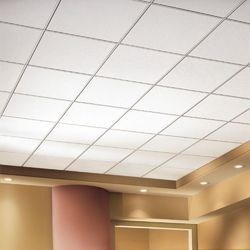
 What is Suspended Ceiling and where is it applied? What are the types, applications and materials of Suspended Ceilings? What are the purpose and usage areas of Gypsum Board Suspended Ceiling, Metal Suspended Ceiling, Rockwool Suspended Ceiling, Tiled Suspended Ceiling and other decorative Suspended Ceiling types?
Suspended Ceilings are coatings applied to the ceiling for insulation, decorative and lighting purposes in homes, offices, workplaces in general. Electrical cables, water pipes and ventilation ducts running through the ceiling can create a bad image. In these cases, different suspended ceiling models are applied to the space in order to prevent the bad image. Suspended ceilings can be applied in order to apply different lighting models and to cover the exposed concrete on ceilings that are not plastered.
Drywall Suspended Ceiling
Plasterboard Suspended Ceiling, which is easier to apply than others, is used to prevent installations passing through the ceiling, to create a flat and clean appearance, and to provide a different lighting ambiance. It is frequently used in places such as bathrooms, living rooms, offices, stores. You can create different types of lighting by making hidden light bands with a plasterboard suspended ceiling and add a more pleasant atmosphere to the environment.
How is a plasterboard suspended ceiling applied? Suspended Ceiling carrier system is prepared with galvanized U and C profiles. It can be used in box profile instead of galvanized profile. After the carrier system is prepared, drywalls are screwed on the horizontal profiles with self-tapping screws. Joint tape is applied to drywall joints in order to prevent cracking during jolts. It is made of satin plaster. Then the paint process begins.
Rockwool Suspended Ceiling
It is applied by placing tile rockwool plates on the carrier system. It is found in many places because it is easy to work and cost-effective. It contributes to sound and heat insulation. It creates a comfortable environment. It can be easily disassembled and mounted.
The carrier system of the rockwool suspended ceiling differs from the plasterboard suspended ceiling. After the T24 carrier system is formed, the rockwool tiles are easily placed.
Metal Suspended Ceiling
These are suspended ceiling systems that are applied by laying metal tiles after the T24 carrier system is formed. It can be applied in dimensions such as 30×30 cm 60×60 cm 60×120 cm. It is often seen in areas such as shopping malls, hospitals, metro stations. Different suspended ceiling models can be applied according to the carrier system and plates such as Lay-on, Lay-out, Clip-in, Hook-on, Mesh, Baffle suspended ceilings.
Clip-in suspended ceiling system, suspended ceiling plates must be interlocked and the carrier system is hidden. It is not visible from below.
Lay-on suspended ceiling system, suspended ceiling plates must be interlocked and the carrier system is visible from below.
Lay-in suspended ceiling system, suspended ceiling panels appear a certain amount lower than the carrier system.
Mesh suspended ceiling systems prices, suspended ceiling panels have the appearance of a grid.
There are many types of Suspended Ceilings. Different designs are also prepared according to the creativity of the architect.
Suspended Ceiling Manufacturing Stages and Suspended Ceiling Materials
The materials generally used in the manufacture of Suspended Ceilings are as follows. Dowels, Hanger Rods, Hanger Tongs, Clips, Attachments, Carrier Profiles, Side Profiles, Z profiles, Galvanized U and C Profiles, Box Profiles are used.
Suspension bars with steel dowels are fixed to the ceiling at intervals specified in the project. The carrier profiles are connected to the hanger bar with the hanger tongs. If a metal suspended ceiling is to be made, T24 carrier elements are attached to the suspension rods in two directions to form a grid. A more aesthetic appearance can be created by making drywall tape on the edges of the metal suspended ceiling. However, it should be worked with millimetric margins of error so that the metal plates fit together perfectly and there is no confusion in the joints. Measurements should be taken meticulously. If the walls are crooked, the joints in the suspended ceiling panels may be distorted. The skews on the wall should be detected and taken into account in the ceiling dimensions.
If a plasterboard suspended ceiling is to be made, the galvanized ceiling C profiles are connected to the suspension rods in two directions to form a grid. Drywalls are screwed to ceiling C profiles with self-tapping screws.
 Flooring Systems